AI-Powered
 Eastern Shipyard Bulkhead Helical Anchor Installation
The Challenge
A planned bulkhead expansion at a shipyard called for the installation of helical anchors to tie back the structure.
The Solution
Helical anchors were installed into the new bulkhead structure.
The Impact
A third-party engineer verified the strength of the helical anchors and the bulkhead extension was opened for use by the shipyard.
 Location: Panama City, Florida
 Project Type:
  Repair Type: Seawall and Bulkhead
The Challenge
A bulkhead extension at this shipyard required reinforcement to ensure long-term stability.
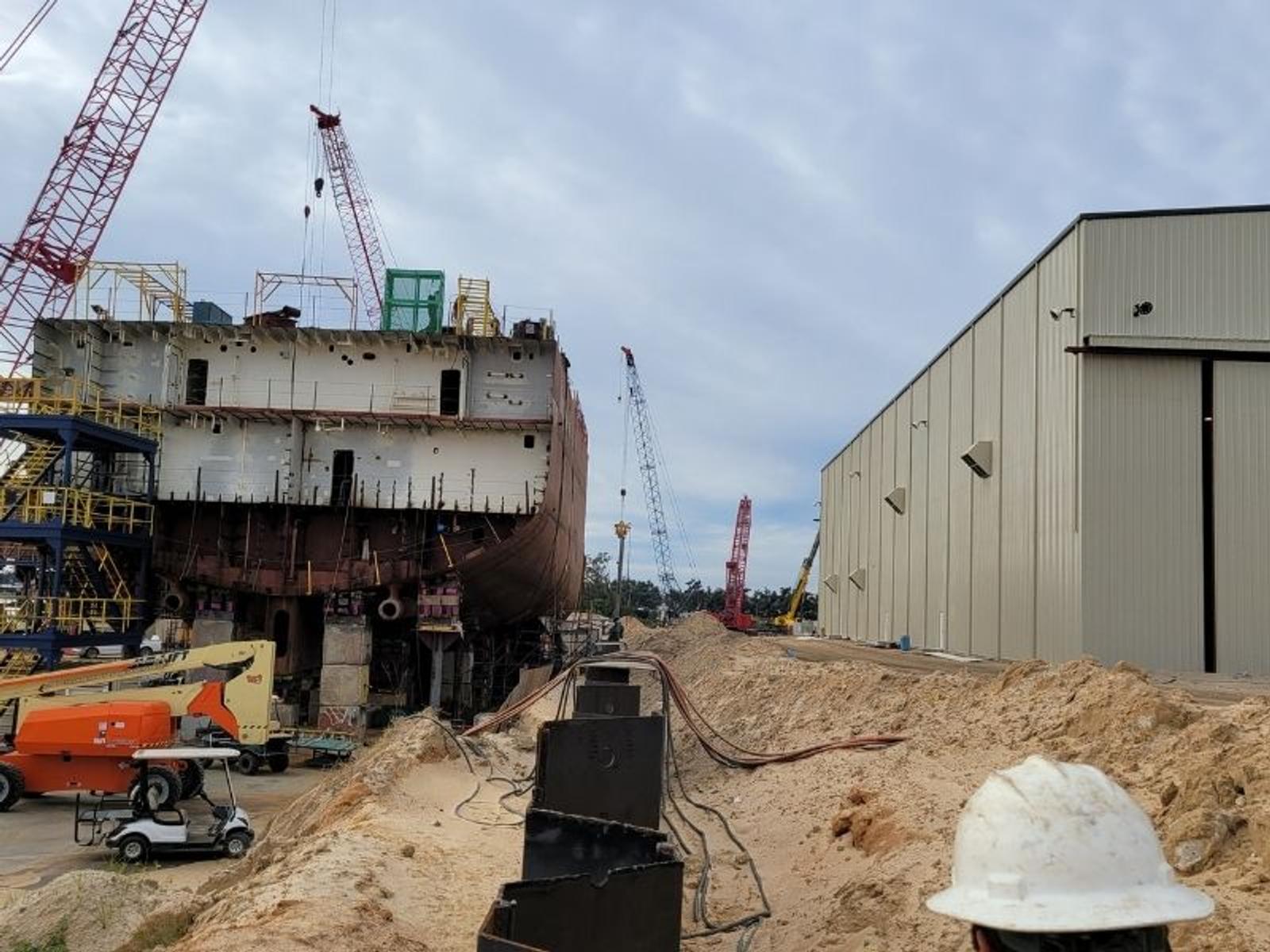
At Eastern Shipyard in Panama City, Florida, the bulkheads face hardship every day. Between the consistent lapping of water from St. Andrew’s Bay and the heavy equipment used to build United States Coast Guard ships called cutters, the bulkheads in this shipyard stand on the front line of both nature and industry, absorbing constant wave energy and the weight of active shipbuilding operations. This structure plays a critical role, retaining shoreline soils and preventing saltwater intrusion while withstanding seasonal storms and hurricane events. As part of planned expansion, an additional uphill bulkhead was required. Groundworks was engaged to install helical tiebacks to reinforce the new extension and ensure long-term performance. In a high stakes area coping with the harsh forces of nature, a strong solution from Groundworks meant the difference between a failing bulkhead and a lasting structure.
Key Facts
Driven 42′
Laterally into Soil
15°
Installation Inclined Angle
5′
on Center
105 Kip
Ultimate Tension Capacity
The Solution
Helical anchors were installed to tie back the structure.
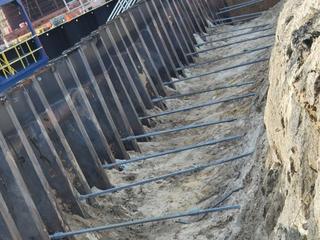
To ensure the structural integrity and durability of the wall, Groundworks was subcontracted for helical anchor installation to support the extension of the bulkhead. The sheet pile walls that comprised the bulkhead were installed by the general contractor, HG Harders, while Groundworks installed helical anchors. These anchors were installed approximately 5 feet on center using a hydraulic torque motor that rotated the helical shafts on average 42′ laterally into the soil. Each anchor consisted of a 1 ¾” x 1 ¾” steel shaft with a multiple helical plate configuration (10”, 12”, 14”, and 14”), which was installed at an inclined angle of 15° from horizontal in order to achieve the specified ultimate tension capacity of 105 kips. Installation torque was monitored throughout the process to verify that each anchor achieved the torque required to support uphill bulkhead. This load was selected due to the heavy cranes transporting ship modules along the length of the bulkhead.
The Impact
Third party engineers verified the design load of the newly installed helical anchors.
The efficacy of the tieback installation was evaluated by a third-party engineer, who performed proof and performance tests. During this testing, anchors are randomly selected which will comprise the test sample. Selected anchors were subjected to controlled tensile force of two times the design load using hydraulic jacks to measure displacement under load. The resulting load-versus-deflection data was recorded and analyzed to confirm compliance with the specified 105-kip ultimate tension capacity. In each case, the performance tests found total movement after a 10-minute period an average of 0.003″ to be much less than 0.12” (the established maximum movement criteria). Following the load tests, the anchors and the bulkhead were confirmed to have achieved the required load bearing capacity. The completion of this project increased the load bearing capacity behind the bulkhead and allowed the shipyard to continue its daily operations and begin work building ships near the bulkhead extension.
Trusted by Industry Leaders Nationwide
Leading brands across government, commercial, and industrial sectors choose Groundworks for their most challenging projects.