AI-Powered
 Caliterra Ranch Utility Trench Stabilization
The Challenge
A poorly compacted utility trench resulted in the settlement of the aboveground roadway.
The Solution
Groundworks performed deep soil stabilization to recompact the soils in the utility trench.
The Impact
The underlying soils were stabilized with a long-term solution.
 Location: Wheatland, California
 Project Type:
  Repair Type:
 Utility trenches are particularly susceptible to soil instability and settlement, especially when installed as part of new construction projects. After utilities are placed, trenches are backfilled with soil, but the confined space and construction timelines can make proper compaction difficult to achieve. As a result, trench backfill often remains looser than the surrounding native soils.
Over time, this loosely compacted soil can settle under the weight of the structures above or from constant vibrations caused by traffic, equipment, or nearby operations. In addition, inflow and infiltration (I/I) from groundwater or surface water can further weaken trench backfill soils. Together, these factors can lead to settlement that affects the ground surface and structures above the utility corridor.
The Challenge
Poorly compacted backfill in a utility trench allowed the roadway to sink.
At a new residential development in California, multiple streets had settled after roadway construction. After geotechnical evaluation, it was confirmed the source of the problem was poorly compacted backfill in the sewer trench beneath the roadway. Cone Penetration Testing (CPT) confirmed zones of low tip resistance beneath the pavement, indicating weak and variable trench backfill soils extending to utility depth. Further complicating the problem was the fact that traditional excavation and re-compaction would not work, because it required breaking up the pavement, exposing utilities, disrupting the neighborhood and traffic, and overall more risk.
Key Facts
424
Injection Points
60,900
Pounds of Polyurethane
CPT
Cone Penetration Testing
1,680
Feet of Stabilized Roadway

The Solution
Polyurethane injections to stabilize the backfill.
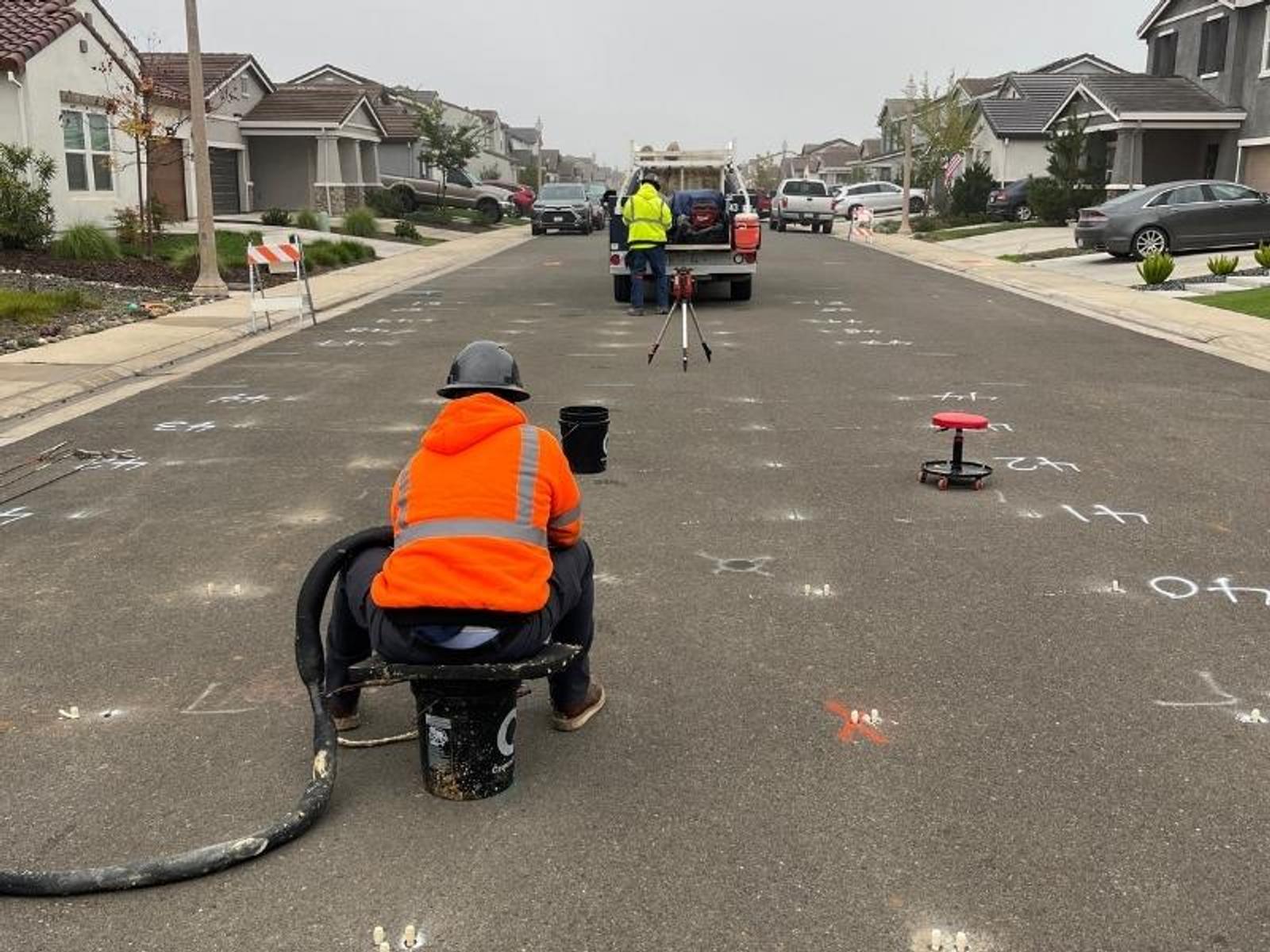
To resolve this problem, Groundworks needed a solution that would stabilize the poorly compacted utility trench backfill, without excavation or disruption to the neighborhood. To do this, they implemented a deep polyurethane injection ground improvement program.
Polyurethane is an excellent solution for compacting soils underground, without excavation. This is because the dual component product is injected directly underground, where it reacts and has a controlled expansion. During expansion, the polyurethane is restrained by the surrounding soils and aboveground structures, causing the loose soils to be compacted.
Injection work targeted the mainline sewer trench beneath multiple streets using a grid-based injection pattern. Injection points were spaced approximately four feet on center along the roadway, with multiple injection depths targeting the full trench profile while maintaining careful clearance from existing utilities. Prior to full installation, three test sections were installed to evaluate injection patterns, depths, and foam quantities. The test program included post injection Cone Penetration Testing (CPT), test pit excavations, and detailed foam volume tracking to verify soil improvement performance. Based on the results, the project team, working in real-time coordination with the geotechnical engineer, contractor, and municipality, refined and optimized the injection procedure to account for variability in site specific backfill conditions.
Full scale injections were completed between October and December 2025 under independent observation by ENGEO, a licensed California geotechnical engineering firm.
The Impact
The soils and the roadway were stabilized.
In total, approximately 1,680 linear feet of roadway were treated using 424 injection points, with roughly 60,900 pounds of polyurethane installed. Independent engineering review concluded that the injection program is expected to significantly reduce the likelihood of future settlement within the treated trench areas.
This project demonstrated effective re-compaction of backfill without requiring excavation, exposure of utility lines, or interruption to the daily activities and driving of local residents. This method of installation was adaptable around the existing utilities, minimizing risk to both workers and those nearby.
This project showcases a solution that is versatile across utility trenches experiencing the same problem of settlement that affects paved surfaces. It is ideal even in situations where access is limited, there are live utilities, or traditional excavation is not possible.
Trusted by Industry Leaders Nationwide
Leading brands across government, commercial, and industrial sectors choose Groundworks for their most challenging projects.