AI-Powered
 Groundworks Stabilizes Shoulder and Bridge Transition on Route 242
Contra Costa County, CA
The Challenge
Route 242 in Contra Costa County was experiencing soil destabilization.
The Solution
Groundworks injected a high density polyurethane chemical grout below the slab.
The Impact
Groundworks with the use of high-density polyurethane brought forth a substantially more stable base support.
 Location: Concord, California
 Project Type:
  Repair Type:
 The Challenge
With just under 395K miles of roadway in California, Caltrans is challenged to stretch every tax dollar to ensure Californians have roadways that are safe and have an optimal useful life. On Route 242 in Concord, CA, Caltrans is undertook a major highway improvement project that balances replacement with maintenance in order to keep the roads moving. On one portion of the Route 242/680 Separation to Buchanan Field Viaduct project, Groundworks was brought in to stabilize 270′ of roadway with its polyurethane chemical grout application.
The 270′ area consisted of 3 major sections; the Clayton Rd. overpass bridge approach, the Willow Pass Bridge Approach, and 240′ of an on-ramp shoulder which was in dire need of soil stabilization.
The Clayton Rd and Willow Pass Bridge approaches were both experiencing similar issues. Over time, with vibration caused by heavy traffic flow, the soils underneath the slab had consolidated and lost effective bearing capacity to support the bridge transition. The slabs were beginning to show signs of settlement and Caltrans wanted to stabilize the soils before it was too late.
Key Facts
270 Ft
Required Stabilization
8 Days
Installation Time
Evening
Operations
7 Ft
Polyurethane Injection Depth
The Solution
Soil Stabilization and Roadway Reinforcement using high density polyurethane chemical grout.
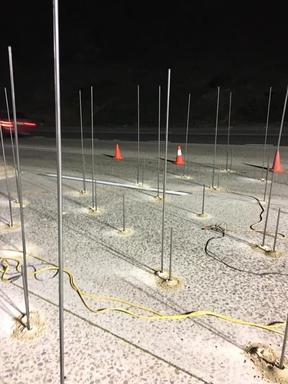
To stabilize the soils, Groundworks injected a high density polyurethane chemical grout below the slab at 3′ and 7′ depths on a 4′ grid pattern. For both Clayton Rd. (a 50′ x 28′ injection area) and Willow Pass (a 36′ x 24′ injection area) the goal was to densify the base soils by creating a solid soil zone in the upper 3′ injection depth, and then inject at the 7′ depth to densify the soils against the newly compacted top layer and roadway. The result was substantially more stable base soils that are better protected against future soil subsidence and will better support the bridge transitions.
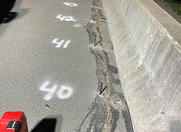
The on-ramp shoulder was experiencing a separate issue. This section of Route 242 is an elevated highway built on earthen embankment. Along the stretch of roadway between the Clayton Rd. and Willow overpasses, the slope of the embankment had experienced substantial erosion that was causing the shoulder and roadway to pull away toward the slope. (Here is a street level view of the shoulder.) To combat the issue, Groundworks was tasked with stabilizing the shoulder and roadway with a single line of injections at 7′ depth for 240′ at 4′ intervals along the shoulder. This process helped reinforce the road base and prevent it from slipping further. After the injections were completed, a cement compaction grouting contractor was tasked with stabilizing the slope.
The Impact
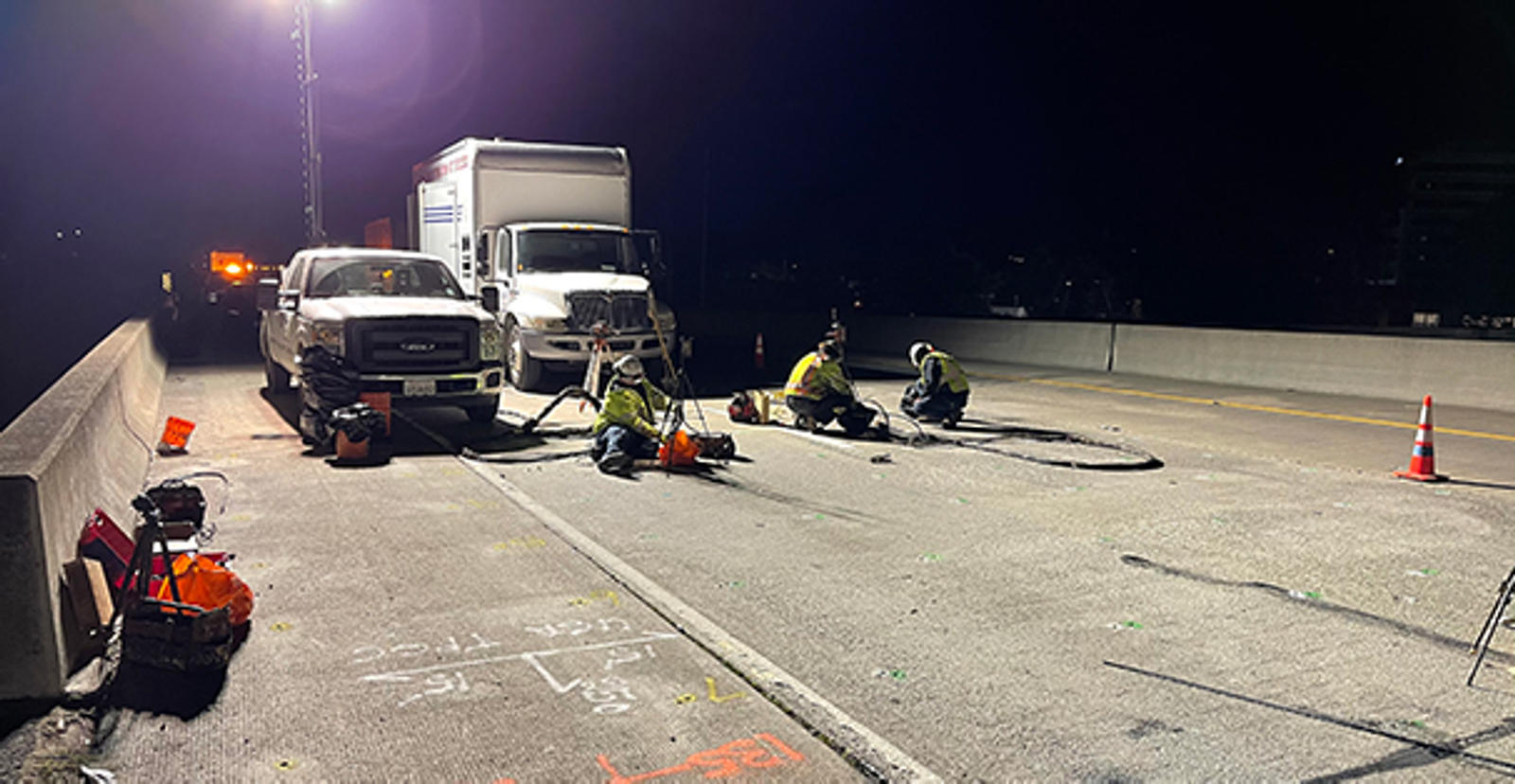
Nighttime Roadway Stabilization for Long-Term Results completed over 8 days.
In order to minimize community impact, the roadway stabilization project was completed over 8 days, with all of the work taking place in the evenings with normal traffic rerouting being used for traffic control. The project helped avoid complete roadway replacement and stabilized the roadway for many years to come.
Trusted by Industry Leaders Nationwide
Leading brands across government, commercial, and industrial sectors choose Groundworks for their most challenging projects.