AI-Powered
 The State of the American Home at 250: Why 1 in 3 Homeowners Can’t Spot the Problem That Could Cost Them the Most
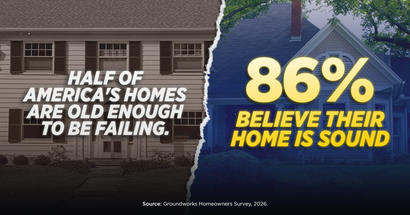
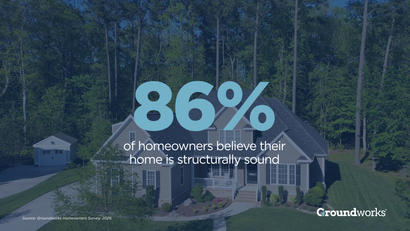
Right now, you probably believe your home is in good shape. According to a new Groundworks survey of 2,000 American homeowners, 86% said they’re confident their home is structurally sound. However, here’s the unsettling part: most of them couldn’t actually prove it.
We notice the things we can see: the paint that’s peeling, the faucet that drips, the carpet that’s seen better days. But the most important part of your home is a part you rarely see: your foundation, holding everything together from the ground up.
As America celebrates its 250th anniversary this year, we’re living in the oldest housing stock the country has ever had, and the gap between how secure we feel and what’s happening beneath our feet has never been wider. Here’s what the data says you might be missing.
Why Homeowners are Confident, But Can’t Verify It
If you’re in that 86% (and statistically, you probably are), here’s the question worth sitting with: when was the last time anyone checked? And if you did check, would you know the warning signs if you saw them? Because when you ask homeowners whether they could spot a problem themselves, the confidence starts to thin out.
36% of homeowners admit they wouldn’t know how to check for foundation or basement trouble on their own. 50% say they only have a basic grasp of how weather and soil affect what’s holding their house up. And still, 82% of homeowners say they feel in full control of their home’s long-term safety. Side by side, those facts paint a concerning picture. If a problem were quietly taking root below the surface, the majority of homeowners likely wouldn’t know until it forced its way into view.
The Demand No One Sees Coming
The gap between homeowner confidence and foundation security is widening. Groundworks’ own field data shows foundation repair demand has surged more than 20% in the first five months of 2026 alone. More than 100,000 times a year, our experts are under an American home, seeing what the homeowner can’t. When something starts to change beneath the surface, we see it first.
It’s not just that more people are calling. It’s that more of the homeowners who receive inspections are finding real problems, like foundation settlement, bowing walls, and gaps between walls and floors. As homes age and the soil around them weakens, these issues become major safety hazards that require professional intervention. While homeowners have never felt safer, their homes have never been more at risk.
The Cost of Waiting Is Real — and Uninsured
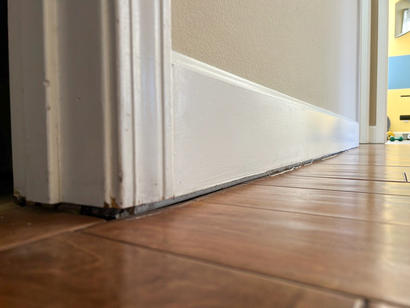
By the time structural warning signs appear, what started as an invisible problem can become a major financial burden, leaving homeowners responsible for the full cost of repairs. Homeowners expect to spend around $70,000 maintaining a home over a lifetime. The real number is more than $339,000 for routine upkeep alone.
Most homeowners assume that if something goes seriously wrong, insurance will cover it. But when it comes to foundation damage caused by soil movement, drought, and settling, it may not be covered by standard homeowners policies. When that bill arrives, most homeowners are left covering far more of the cost than they ever expected. Which is why it’s no surprise that 65% of homeowners say they’d feel they’d let their family down if a repair they put off turned into a financial blow.
America’s Homes Have Never Been Older
There’s a bigger force behind all of this, and it’s deceptively simple: the American home is getting old. Nearly half of all U.S. homes — 48.66% — were built before 1980, according to First American Data & Analytics, covering roughly 161 million homes. Groundworks experts note that homes from this era are the ones where foundation problems most often begin to surface, as decades of soil movement, moisture cycles, and natural settling take their toll.
The median American home is now 44 years old, the oldest on record. Meanwhile, an estimated 38.4 million homes built between the 1970s and 1990s are now entering their 40-year mark, a point at which structural attention historically begins to accelerate.
Home Health by Region
In the Northeast, more than two-thirds of homes predate 1980; the highest concentration in the country. Across the Midwest, more than 61% of homes predate 1980, and near-universal basement construction in states like Michigan, Illinois, and Wisconsin means most homeowners are living directly above the most structurally vulnerable part of their house.
The South tells the most surprising story of all. With just 37% of homes predating 1980, it has the newest housing stock of any region in the country. By that measure, it should be the safest. Instead, 39% of Southern homeowners say they’ve discovered a structural problem more serious or more costly than they expected, the highest rate of any region.
“It’s not the age of the home that causes structural movement – it’s the soil beneath it,” said Jeffrey Martin, Chief Operating Officer of Groundworks. “A newly built home and a century-old home can experience the exact same foundation issues when soil conditions change.”
Why Homeowners Need to Protect their Investment
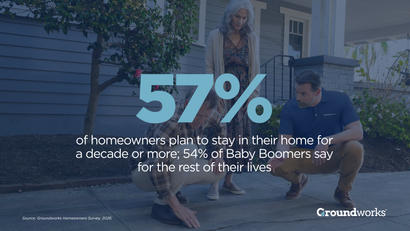
The continuing threat of foundation damage can carry significant consequences for the millions of Americans who plan to stay in their homes for the long haul. 83% of homeowners plan to remain in their current home for at least five more years, and 57% plan to stay a decade or longer. Among Baby Boomers, 54% say they intend to stay for the rest of their lives. These are forever homes, in the most literal sense.
The people with the most riding on their home’s future are often the least equipped to protect it: 59% don’t have a certified professional they trust to call about a foundation or basement concern. They’ve committed to the house. They just don’t have anyone in their corner who knows what’s happening beneath it. That’s a gap worth closing, because the homes Americans are choosing to stay in the longest are often the ones most at risk of structural problems.
The Real Foundation of Home Confidence
As America turns 250, the homes we’re living in carry more history, and more accumulated wear, than at any point in this country’s life. You won’t see your foundation today, or tomorrow, or most days. But everything you love about your home rests on top of it. Catching a foundation problem early is the difference between a small repair and a major one.
So, before the next renovation, or simply before another season turns, it’s worth a closer look. A free inspection from the foundation repair experts at Groundworks is the best way to protect the biggest investment you’ll ever make. We’re committed to protecting American homeowners from lasting foundation damage, and we’re ready to provide you with lasting peace of mind. Contact us today to schedule a free inspection.
Survey Methodology
Groundworks commissioned Atomik Research, part of 4media group, to conduct an online survey of 2,000 homeowners of single-family homes and townhomes throughout the United States. The margin of error is plus or minus 2 percentage points at a 95 percent confidence level. Fieldwork took place between May 27 and June 2, 2026. Regional subgroup data for the South reflects n=518 respondents (margin of error approximately plus or minus 4 percentage points). Property-stock figures are drawn from first-party residential property records covering approximately 161 million U.S. homes.
Foundation Inspection FAQs
It’s a good idea to get a foundation inspection every couple of years, especially if you notice damage. If you work with Groundworks to repair your foundation, you can take advantage of annual service and maintenance programs that include evaluations of your home and any repair solutions installed.
Inspections from people like engineers typically cost a few hundred dollars. This is helpful, and they recommend repairs and oftentimes companies that can install them. However, it’s a good idea to seek assistance straight from a foundation repair professional, like Groundworks, who will conduct a free inspection and provide you with an honest, transparent, and no-obligation repair estimate.
Several symptoms—such as wall cracks—you can check for on your own. However, it’s best to have a foundation repair professional perform a thorough evaluation of your house. That way, you’ll know exactly what’s going on with your foundation and how to repair it effectively and permanently.
Related Resources